Why Tailored Emission Control Matters in Paints & Coatings Industry
In Paints & Coatings manufacturing, generic equipment and off-the-shelf systems often miss the nuanced hazards and performance variables unique to each plant. One-size-fits-all equipment can result in significant downsides, like: inefficient cleaning cycles, insufficient allergen segregation, uneven airflow and energy waste. Which results in multiple retrofit investments and unexpected downtime. JOA’s proven process diagnoses the root causes at your site, delivers tailor-engineered solutions correctly the first time and avoids costly repeat purchases.
Through data-driven design, thorough implementation and continuous optimization, we ensure your investment delivers lasting gains in:
Safe & Healthy Work Environment
Compliance with latest Legislation
Process Efficiency
Enhanced Product Yield
Waste Heat Recovery
Main challenges in the Paints & Coating Manufacturing
Paints & Coating industry operations face tightly interwoven technical, operational, and regulatory challenges that cannot be solved by off-the-shelf equipment alone. Key complexities include:
Stringent & Evolving Regulations: Constantly tightening limits on VOCs and hazardous‑air pollutants force frequent reformulation of coatings and installation of new abatement equipment, driving up R&D and capital costs; noncompliance risks heavy fines and production halts.
Operator Safety: Solvent‑borne resins and fine pigment dust expose workers to respiratory and dermal hazards, so facilities must invest in high‑capacity ventilation, supplied‑air systems and rigorous safety protocols, adding to both CAPEX and OPEX.
Polluted Waste Heat Streams: The exhaust from curing ovens and flash‑off tunnels is loaded with solvent vapors and fine paint mist. These pollutants adhere to surfaces, forming sticky, insulating layers that hinders thermal transfer. Making waste‑heat reclamation technically difficult and economically unattractive.
Odor Complaints: Paint production leak odor‑causing VOCs that can travel beyond the plant boundary; operators must retrofit activated‑carbon filters, extended‐height stacks or biofilters, all of which add footprint, maintenance and costs.
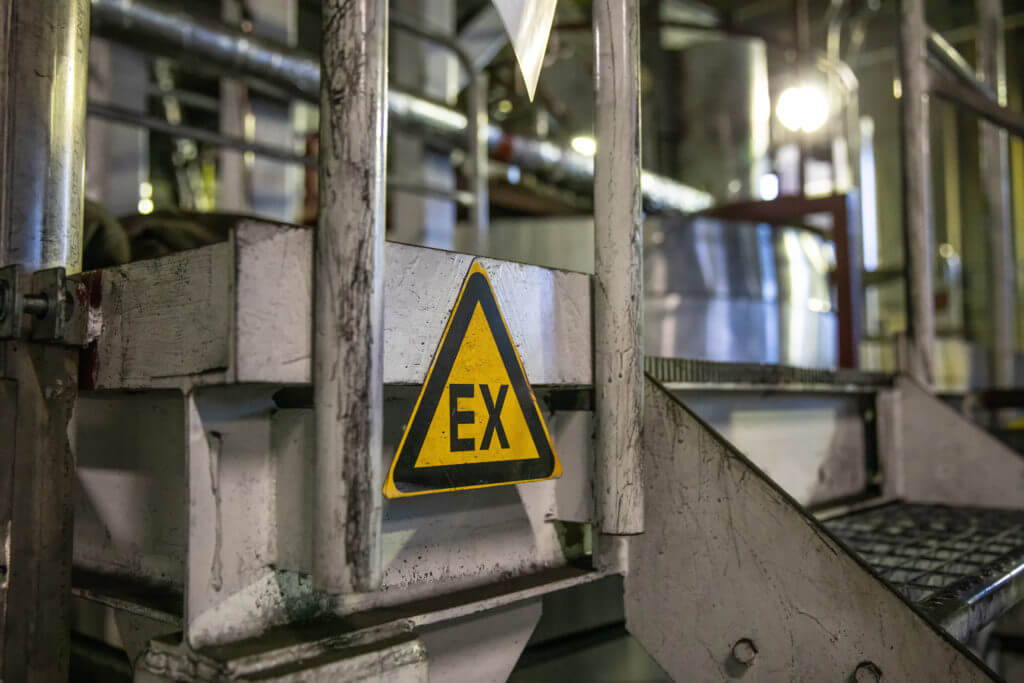
Explosion Safety & ATEX Compliance: Solvent vapors and combustible dust create explosive atmospheres requiring ATEX zoning, flameproof motors, grounding systems and regular revalidation; the specialized equipment and engineering effort substantially raise project complexity and expense.
The processes we commonly see when these challenges occur are:
Drying and curing ovens
Mixing, blending, and solvent handling areas
Cleaning stations (tank cleaning)
Bagged powder dumping
Inspection areas for hatches, lines, etc.
Dust extraction points
During paint and coatings manufacturing, a broad range of airborne contaminants are produced. These emissions including fine pigment or filler dust, overspray mist, solvent vapors, sticky resins, and strong odors, can pose health and safety risks, compromise product quality, create fire/explosion hazards, and demand extraction and abatement solutions. Below are typical substances and emissions encountered in the paint and coatings production environment:
| Cadmium | Coatings for the Automotive Industry | Dyes |
| Exhaust Gases | Fillers | Hexavalent Chromium |
| Inks | Laminates | Latex |
| Phosphates | Pigment (powder) | Pigments |
| Polycyclic Aromatic Hydrocarbons (PAH) | Polyester | Polyurethane |
| Powder Coating | Silicones | Solvents |
| Surface Coatings | Toner and ink | UV protection |
| Vinyl | Volatile Organic Compounds (VOCs) | Wet Paint |
| Zinc Oxide |
Case Studies Paint & Coatings Industries

Ammonia Emission Reduction by Chemical Scrubber
Ammonia‑laden exhaust at a major FMCG site in Eastern Europe with a custom three‑stage chemical scrubber: after an in‑depth pre‑engineering study and CFD‑driven design, the system removed over 80 % of ammonia and odor‑causing acids, captured 95 % of dust, and even integrated waste‑heat recovery for energy savings.
How does JOA solve Challenges in the Paint & Coatings Industry
Efficient paint and coatings production requires reliable operations and strict air-quality management. Robust dust and solvent vapor extraction systems are essential to prevent cross-contamination, ensure consistent color and finish, protect operators, and control flammable atmospheres. Frequent batch changes, variable raw material inputs, and the handling of sticky, abrasive, or odorous compounds add complexity and increase explosion risk. These factors make a customized extraction solution necessary, achieved through the following proven process:
Data Collection & Measurements: Every process step can release emissions. In the Pre‑engineering study we measure on site and observe each operation. We target feeders, weigh stations and transfer points. The data reveals exposure risks such as cross‑contamination, operator hazards and regulatory breaches. These findings guide the new system design.
Consultancy & Design: Raw data alone isn’t enough. Our in-house Air Technical Modeling (GCM™) and expertise allow us to visualize airflow, identify fouling hotspots, and map out cross-contamination risks. Our engineering team develops solutions that prioritize cleaning access (CIP/SIP) and material choices that meet ingredient safety standards (e.g., stainless steel, FDA-compliant plastics)
Building & Implementation: System realization begins with pre-fabricated assemblies that undergo factory acceptance testing (FAT) to minimize on-site installation time. Coordinated scheduling with plant maintenance reduces production interruptions while experienced project managers ensure seamless commissioning.

Why JOA is the Right Partner for the Paint & Coatings Industry
By partnering with JOA, Paint and Coating manufacturers can achieve the highest quality standards, ensuring product integrity and operational excellence.
Tailor-made Solutions
Developing customized systems that address the unique challenges of each client.
Air Technical Modeling & CFD Analysis
Utilizing advanced computational methods to design efficient emission control systems.
Process Guarantees
Ensuring that implemented solutions meet performance expectations and regulatory requirements.
Extensive Experience
A proven track-record of working with leading companies on complex industrial processes.
In conclusion, effective emission control and dust collection are integral to the success of paints and coating manufacturing. JOA’s expertise in providing tailored solutions ensures that companies can maintain clean and efficient operations, meeting the stringent demands of the industry.
Contact us
Share your challenge
Plan a short 30 minute meeting with one of our engineers who have experience with manufacturers worldwide, and start improving your industrial process.
Share details about your challenges
We will review your challenge and plan a meeting
Discuss what is happening at your site
Paints and Coating FAQ
We use process mapping and real-time/periodic monitoring to create a complete solvent mass balance. JOA systems are designed to capture both channelled and fugitive emissions, with extraction and abatement sized for current BAT-AELs and flexible enough for stricter future limits (e.g., ZZS/MVP). We deliver documentation, measurement, and reporting protocols that satisfy authorities and simplify audits.
JOA systems are specified with ATEX-certified equipment for the appropriate zone (1/2), with grounding, explosion venting, and monitoring. We design for worst-case solvent/vapor concentrations, including process upsets, to always keep below 10% LEL. Our fans, filters, and controls all meet or exceed ATEX and process safety requirements. For recirculation, we ensure continuous LEL measurement and automatic shutdown if risk increases.
We identify all odorous sources, use targeted extraction and abatement (combining carbon, chemisorption, and thermal technologies as needed), and create actionable odor management plans. JOA systems are sized for peak odor loads and configured for responsive feedback when complaints are received or detected.